 Experience Works
Ground foraging and hand gathering
Wiki home · Getting started · Stone Pebble
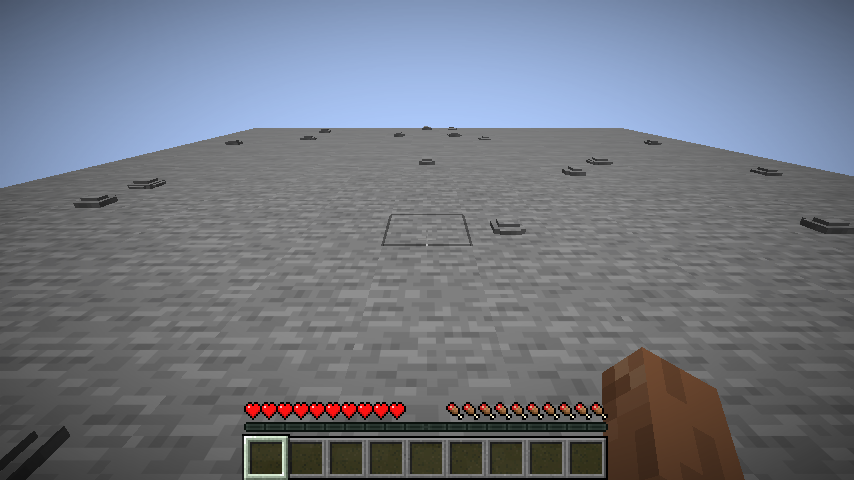
In-game pebbles placed by the habitat-aware generation feature on a controlled exposed-stone test patch.
Natural generation is habitat-specific: fallen sticks appear only near leafy trees, and pebbles are concentrated on or near exposed surface stone or gravel, with occasional pebbles on other open soil. Open grassland can receive sparse pebbles, but no sticks without trees. They are placed blocks until harvested, so they do not despawn like dropped item entities. Forest canopy leaves are ignored when finding the ground surface. Sticks can lie on grass and forest soils such as dirt, podzol or mycelium. Pebbles can lie on those soils or directly on supported dry rock/gravel surfaces. Generation does not replace flowers, grass plants, fluids or occupied blocks.
Right-click either object to remove it and drop one Stone Pebble or one ordinary Minecraft Stick into the world. You can also break it normally. Removing its supporting block makes it break and drop. Objects have no collision. Collect the drops normally. No XP is used.
Four Stone Pebbles in a 2×2 square craft one Cobblestone. Empty-hand mining of Dirt or Grass Blocks additionally has a 25% chance of one pebble, without replacing the normal Dirt drop. This bonus uses the actual tool used for the break, so a shovel breaking on its last durability does not count as hand digging.
Difficulty changes the early-game rules immediately:
- Peaceful / Easy: normal hand-log mining speed; logs can be vein-mined by hand.
- Normal: logs take twice as long by hand or with ordinary held items; vein-mining logs requires an axe or compatible faster log-mining tool.
- Hard: Normal’s log rules, plus wooden pickaxes, axes, shovels, hoes and swords cannot be crafted or used and are hidden from creative item lists and Recipe Tree browsing. Existing tools are retained rather than deleted.
Axes and compatible faster tools otherwise retain normal speed. Creative hand breaking stays instant. Other vein-mining eligibility and the four-block limit remain unchanged.
Where they generate
- Sticks: within 5 horizontal blocks of a trunk with at least two connected vertical log blocks and a nearby leafy canopy. A bare log post does not qualify. Modded trees can qualify through Minecraft’s logs/leaves tags.
- Pebbles: within 4 horizontal blocks of rock or gravel, looking up to 3 blocks above/below the ground level. The source must have an air-exposed top or side face connected to the outdoors. This includes rocky hillsides, cliffs, gravel banks and stony shorelines. Buried rock and enclosed underground air pockets do not qualify.
- The pebble’s own stone/gravel floor can be the exposed source. Water, plants and occupied positions are never replaced. A shallow cliff overhang is allowed if its open face reaches an outdoor column within two horizontal blocks.
- Exposed rock patches receive a separate 24 extra pebble attempts per chunk, biased around detected dry surface outcrops. When no top-facing patch is found, these attempts still check the normal exposed cliff/edge habitat. This makes outcrops denser without increasing open-plains background scatter.
- Away from exposed rock, otherwise suitable open-soil pebble attempts have a 10% acceptance chance. Near exposed rock, eligible attempts retain the full rate; this is not a 10% chance per ground block.
- Only available worldgen chunks are inspected; neighbouring chunks are not force-loaded. Rules apply to newly generated terrain. Hand-dug pebble bonuses and player decoration placement use their existing rules.
Defaults and configuration
The early_survival module contains the two ground blocks. Feature switches are surface_foraging, hand_digging_pebbles and slow_hand_logs.
| Tuning key | Default | Effect |
|---|---|---|
early_survival.hand_pebble_chance |
0.25 | Extra pebble chance from eligible empty-hand digs |
early_survival.surface_attempts_per_chunk |
12 | Random attempts, each choosing stones or sticks with equal probability; positions without the matching habitat are skipped |
early_survival.stick_tree_radius |
5 | Maximum horizontal distance to a qualifying trunk (configurable 1–8) |
early_survival.background_pebble_chance |
0.1 | Acceptance chance for pebble attempts away from exposed rock (0–1) |
early_survival.rock_pebble_attempts_per_chunk |
24 | Additional habitat-checked pebble attempts near rock, 0–128 |
early_survival.pebble_rock_radius |
4 | Maximum horizontal distance to exposed source rock (configurable 1–8) |
early_survival.hand_log_break_multiplier |
2 | Normal/Hard break-time multiplier when the held item does not accelerate log mining |
Surface generation affects new terrain. Existing worlds can still obtain pebbles by digging eligible blocks. Generated objects use three model variations and four orientations. Ground sticks drop vanilla Sticks and do not add a second stick item or recipe. experience_works:pebble_sources controls hand-dig source blocks; experience_works:pebble_rock_sources controls nearby source rock (Overworld base-stone types, Gravel and Calcite by default); experience_works:forage_ground controls soil/forest-floor placement. Mining Bags accept pebbles through their mining-drop tag.
World generation · Ground block · Drops and mining multiplier · Vein mining
Inventory-sized stone tools
Join two Sticks diagonally into one Tool Rod. Use the rod with three ordinary Cobblestone for a pickaxe or axe, or one Cobblestone for a shovel, using the orientation-specific 2×2 layouts on the rod’s page. Stone Pebbles must first be crafted into Cobblestone.