 Experience Works
Recipe Tree acquisition sources
Wiki home · Recipe Tree · Recipes
Open an item's recipes in Recipe Tree, then click Sources. Click Recipes to return. Ordinary crafting remains the default when opening an item directly; no hotkeys have changed. This is read-only information: it costs no XP, consumes no materials and starts no crafts.
The top arrows change acquisition category. The lower arrows change source within that category. Scroll over the left card to read longer conditions; scrolling over the right item catalogue still changes item pages. Item icons retain normal recipe/uses navigation and middle-click bookmarks. Back navigation preserves the preceding source view; the last source category/page/scroll is remembered with world/server-specific Recipe Tree navigation.
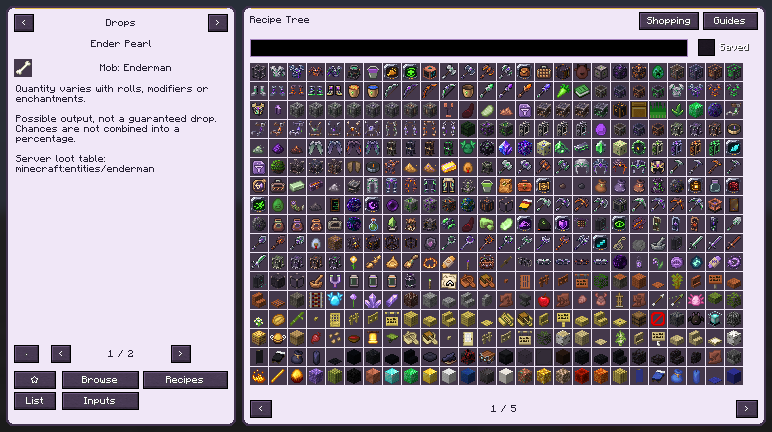
Actual server-provided diamond ore drops and an example valid tool.
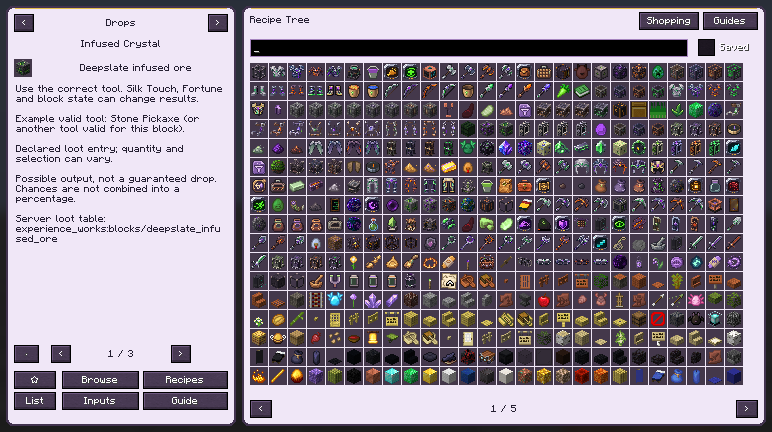
Actual declared ore placement. Scroll for more biome/dimension conditions and source identifiers.
What is indexed
| Category | Information |
|---|---|
| Drops | Block harvest and entity loot tables, nested tables and item-tag entries. Conditions flag tools/enchantments, maturity, entity state, player kills, random/weighted selection, fire conversion and explosion effects. Correct-tool blocks can show an example working vanilla pickaxe. |
| World Generation | Server ore/scattered-ore feature targets, placed-feature height modifiers and biome declarations. Matching loaded vanilla dimensions can show a declared Y band clamped to their build limits. Mod companion ores, End ores and wild blooms have additional source-verified default notes. |
| Gathering | Fishing/gameplay loot tables where declared; mod surface pebbles/sticks, hand digging, tiered pickaxe bonuses, bloom-fed wax harvesting and liquid-XP crystallisation. |
| Trading / Rewards | Chest/reward loot tables and data-defined villager trades, with base payment/output, declared trade-set membership and availability/price caveats. |
Processing remains in normal recipe stations: crafting, smelting, grinding and other registered recipe displays. Sources supplements those recipes rather than replacing them.
Reliability and limits
Loot comes from the connected server's loaded tables, including serializable runtime modifications and datapack replacements. It is not a simulated drop roll. A listed entry is a possible branch, not a promise that every kill/block yields it. Looting, Fortune, Silk Touch, fire, tools, maturity and other conditions may change eligibility, quantities or variants. Complex chances are deliberately not multiplied into a misleading percentage. Independent hand-pebble/pickaxe-bonus rolls can show their actual server-configured probability and qualifying conditions.
World-generation cards describe declarations, not discovered deposits or coordinates. They never inspect chunks or reveal a seed. Height anchors may depend on dimension build limits; generator settings, terrain, host rock, biome modifications and custom dimensions can suppress a declared feature. A biome reference is not a guarantee that a particular world generates that ore. Mod default gathering/worldgen hints are labelled as defaults and may be overridden by integrations or datapacks.
The index is by item type. Component-specific loot transformations, generated trades, runtime spawn rules, arbitrary scripted rewards and custom feature algorithms cannot all be inferred generically. Unknown predicates/modifiers are named rather than guessed. No indexed sources means no known entry, not “unobtainable”. A callback that creates drops outside loot tables requires an explicit source provider. Detailed mob spawning habitats are not inferred from entity loot tables.
The first Sources request builds a cached server index. It is reused for later items and invalidated after datapack sync/reload. Client data clears on disconnect and server sync. Requests and responses are bounded; an additional-sources card explains when a result is capped. Default recipe browsing does not build the source index, and it performs no continuous world scans.
Pack and mod extensions
A server datapack can add files at data/<namespace>/acquisition/<name>.json:
{
  "item": "minecraft:diamond",
  "category": "Gathering",
  "title": "Example custom reward",
  "icon": "minecraft:chest",
  "details": [
    "Describe the actual reward and its requirements.",
    "State any uncertainty or conditions instead of a guaranteed chance."
  ]
}
This adds an information card; it does not implement the reward. Use /reload to refresh server data. Ordinary datapack item/loot/feature/trade resources are indexed automatically where their structure is supported.
Java integrations can register an AcquisitionIndex.register((server, sink) -> sink.accept(itemId, source)) provider at mod startup. Supply an AcquisitionSource(category, title, iconId, details) and derive facts from the integration's own configuration. Providers run during the cached server index build, must be read-only, and must not inspect/load chunks or mutate worlds. This information API does not grant gameplay authority.
Server index and integration hook · Protocol · Client source cache