 Experience Works
Miniature suns and solar electricity
Wiki home · Automation guide · Recipes · Numbers
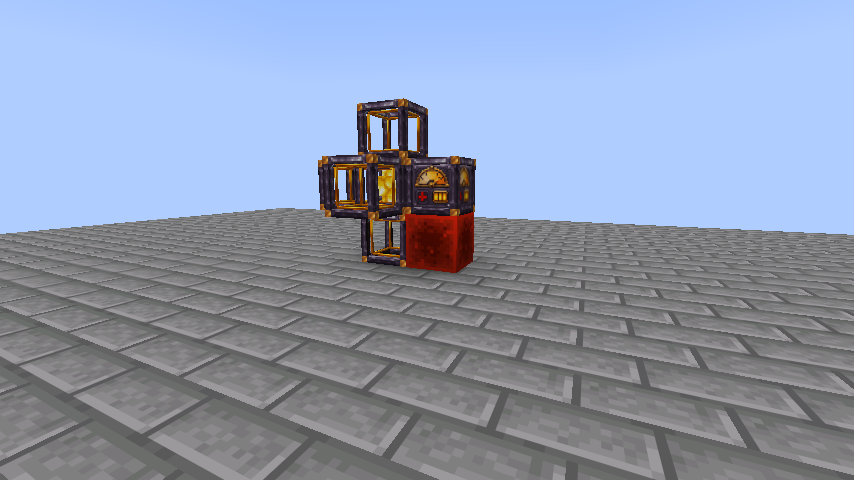
In-game test platform showing a contained sun, released sun, harvester/control enclosure and battery banks.
Make a sun
- Craft a Solar Shield and a Solar Compressor.
- Insert the shield in the compressor. Feed lava with buckets or the existing pump/tank/pipe system. Each bucket adds 1 power over 20 ticks without a boost. Add a bound Power Crystal supplied by its online owner or authorised Player Mirror to the optional second slot for XP-powered acceleration (details below); stop the compressor and remove the shield at the desired power.
- Normal right-click places the shielded sun. Shift-right-click releases an unshielded Miniature Sun, which starts fires and becomes explosive at power 64. An empty shield can capture a bare sun again.
A sun retains its power; generating electricity does not consume its power in this first implementation. The compressor accepts lava only and stores 16 buckets. Max power defaults to 4,096.
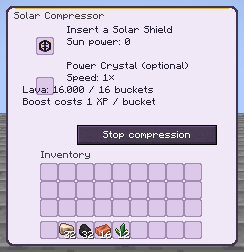
Compressor GUI: shield, optional Power Crystal, current speed, lava amount and Start/Stop control.
Accelerate compression
A bound Power Crystal uses its online owner’s current level or authorised offline mirror’s remaining level: speed is min(64, 1 + floor(level / 10)). Level 30 begins at 4× speed (about four lava buckets per second), level 100 at 11×. Each bucket completed while boosted costs 1 XP point, except in Creative. Spending XP can lower the level and therefore the speed. The crystal stays in the machine. It does not consume an XP level per operation.
Without a crystal, with an unbound crystal or offline owner without an authorised mirror, at levels below 10, or without enough XP, the compressor runs at its free 1× baseline. Stopped machines and full shields consume no lava or XP. The GUI shows the actual speed. Lava may still need to be supplied faster through the pump/tank/pipe system; the compressor tank remains 16 buckets.
Build an enclosure
Enclose the charged, shielded sun using Solar Harvesters and at least one Solar Farm Control. The control harvests too. A flood-fill checks the interior: every outer boundary must be a harvester/control; ordinary stone or glass cannot replace an enclosure block. A second sun or an opening invalidates it. Interior blocks are permitted but can obstruct sight and prevent faces from harvesting. Enclosures can have any connected shape within the configured limits. Air and ordinary building blocks are allowed inside. All boundary/interior chunks must already be loaded; solar machines do not force-load chunks.
The smallest farm fits in a 3×3×3 space: the shielded sun at the center, with one enclosure block directly north, south, east, west, above and below. Five may be harvesters and the sixth the control. The edge and corner positions are optional; only the six face-neighbors are needed for enclosure.
Place batteries/pipes outside the enclosure, adjacent to harvesting blocks. The enclosure is checked every 20 ticks (one second); a breach stops release at the next check. Invalid enclosures leave the sun shielded and safely closed. Right-click the shield or control to inspect the farm. Opening the shield GUI forces an immediate enclosure check.
Default limits: 16 blocks from the sun on each axis; 4,096 interior cells, including the sun. Controls can discover nearby complete farms when opened. Advanced visors show sun power, electricity and enclosure status.
Release and share power
Apply redstone to any control. Signal 0 releases nothing; signal 15 releases full power. Multiple controls use the strongest signal. Full output is sun power energy per tick, divided among all inward-facing harvesting/control faces with direct sight of that sun. Top and bottom faces count. No energy is created by adding receivers.
For a power-16 sun and six visible faces:
- Full signal: 16 total energy/tick, averaging 2⅔ per face.
- Signal 7: 16 × 7 / 15 total energy/tick, shared between the same faces.
- Signal 0: 0 energy.
Energy uses thousandths internally. Generation and division remainders carry/rotate between ticks, so fractions are conserved over time. Each visible receiver block (harvester or control) can absorb at most 16 energy/tick, even if multiple faces see the sun. Its buffer holds 4,096 energy. Shares are weighted by visible face count, then spare shares are offered to other receivers with remaining absorption/buffer capacity. Total absorbed energy never exceeds released energy or the sum of the receiver limits.
A six-receiver farm can absorb at most 96 energy/tick. A power-128 sun at full redstone releases 128, so the farm captures 96 energy/tick and the excess is unharvested. Empty or partially full buffers do not heat the shield. Heat increases only when all visible receiver buffers are full and released energy has nowhere to go. Reduce release to signal 11 or lower, or expand the enclosure to provide at least eight distinct receivers with direct sight of the sun. Adding obstructed blocks does not increase absorption. No higher-tier harvester blocks are added in this pass; the per-block limit is configurable and the allocation supports different per-block capacities.
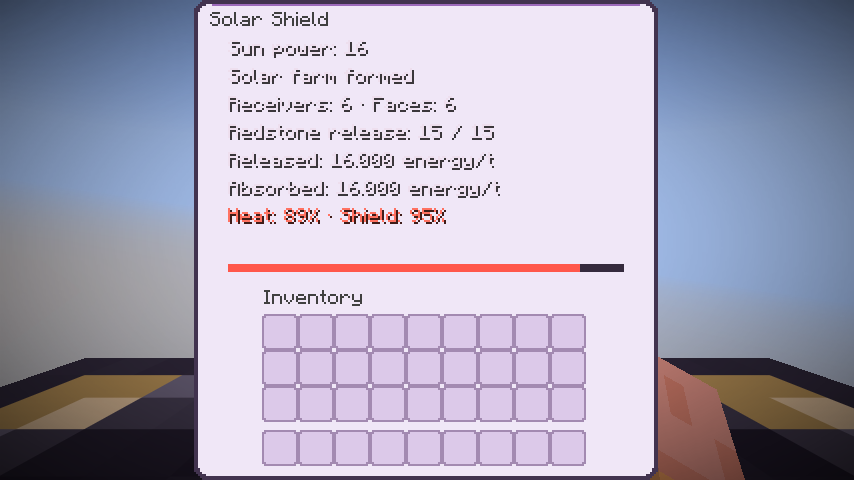
In-game screenshot: shield heat and lasting integrity damage after an overload; the farm is exporting again and cooling.
Store and transport electricity
A Battery Bank stores 1,000,000 energy. Harvesters and controls transfer directly into adjacent batteries, up to 256 energy/tick per connection. Their charge and battery charge persist when broken and placed again.
The existing pipe network carries electricity. Put an Extractor on the source battery/harvester/control, connect Transport Pipes, and put a Depositor on the destination battery. Source and destination can be fractional and transfer exactly the accepted amount; blocked or full destinations do not drain the source. Electricity does not need an item filter; item/fluid ghost filters do not restrict electrical transfers.
Default extractor throughput is 1 energy per 8 ticks (Infused), 16 per 6 ticks (Energised), 64 per 4 ticks (Emblazoned), using the existing extractor batch/interval settings. Electricity routes immediately when transferred; the existing item/liquid animations continue to describe those cargo types. Only loaded routes are searched, within the existing pipe route limit.
The Atomic Reconstructor has an explicit electrical mode; other existing XP machines retain their fuels. See Atomic Soup.
Safety and configuration
A closed shield (redstone 0 or an incomplete enclosure) releases no power and cools down. An open, overloaded farm is dangerous:
- Every tick, blocked output heats the shield only if all visible receiver buffers are full. Exceeding absorption limits while any buffer has room does not heat it. Maximum heat is 1,000, displayed as 0–100%. Heat gain is
ceil(5 × rejected / released)per tick, minimum 1 when energy is rejected. - At 75% heat or more, continued overload removes 5 percentage points of integrity every 20 ticks. Smoke marks a damaging overload; shield/control GUIs and advanced visor details show heat and integrity. Heat below that threshold does not damage the shield.
- When any visible receiver has room, all released energy is absorbed, or release is closed, heat falls by 10 per tick and the damage timer resets. Existing integrity damage remains; cooling does not repair it. Mining and replacing a shield preserves its heat and wear.
- At 0% integrity, the shield breaks and leaves the same-power bare sun in its place. Normal fire/explosion behavior starts from there. With a completely blocked farm, an initially pristine, cool shield fails after roughly 27.5 seconds of loaded ticks at defaults. Partial overload heats more slowly.
Connect every producing block to electrical storage or pipes that can actually move its output, and make sure destination batteries have free space. Shut redstone release off when storage fills; a large battery only delays the problem if nothing consumes or removes its stored energy. Capturing an escaped sun requires a fresh empty shield. The feature switch feature.solar_overheating=false disables containment heat/damage while retaining absorption limits.
A bare sun starts fires with radius min(16, 2 + power / 16) and up to min(64, 1 + power / 8) fire placement attempts per second, with integer division. It needs valid fire positions. Bare suns at power 64+ explode after 100 loaded ticking ticks; explosion radius is min(32, 4 + sqrt(power) × 0.5) by default. Capture them with an empty shield before that countdown finishes.
The solar module has per-content switches and features miniature_sun_fire, miniature_sun_explosions, solar_overheating, and pipe_electricity. Tune solar.max_power, power_per_bucket, compress_ticks, farm_max_radius, farm_max_interior, harvester_capacity, battery_capacity, transfer_per_tick, critical_power, critical_delay_ticks, and explosion_radius_cap. Acceleration additionally uses compression_levels_per_speed, compression_max_speed, compression_boost_xp_per_bucket; absorption uses harvester_absorption_per_tick; containment uses shield_heat_capacity, shield_heating_per_tick, shield_cooling_per_tick, shield_damage_heat_percent, shield_damage_interval_ticks, shield_damage_per_interval. Each of these tuning names uses the solar. prefix. A restart applies tuning changes.
Registration · Enclosure and visibility · Processing, hazards and sharing · Pipe routing
Standard Fabric energy automation can now extract from harvesters/control blocks and insert/extract from batteries. Solar receivers also push to compatible neighboring receivers. One standard energy unit equals one displayed electricity unit; internal fractions are retained. Compatibility guide.
Sneak-right-clicking a harvester with a Solar Shield places the shield/sun instead of opening the harvester menu.
Solar machine and battery readouts use solid dark labels on their pale panels; high heat is highlighted in dark red for contrast.
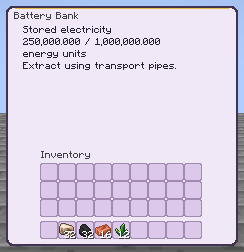
In-game screenshot: dark, unshadowed energy labels on the pale panel.
Windows and exterior heat warnings
Solar Harvesters now have glass-sided forged frames: the shield and miniature sun remain visible through the completed enclosure. All six faces still harvest and form the boundary; the windows do not create openings or change collision. Compressor, control and battery models have different working parts and indicators.
- Below 50% shield heat: ordinary collector channels; no thermal warning.
- 50% to the damage threshold: warm orange seams.
- At the damage threshold (75% by default): red receiver/shield seams and a flashing red control indicator.
- During a damaging overload: smoke is emitted on the outside of the shell, rather than hidden at its centre. Cooling clears the warning as heat falls; it does not restore integrity.
Warnings reflect actual shield heat, not the sun's power or the receiver charge. Exterior warnings refresh within 10 ticks (half a second); disconnected receivers clear stale warnings within roughly two seconds. Smoke is capped at 12 boundary blocks per second. The configurable solar.shield_damage_heat_percent also sets the red-warning threshold; the orange threshold is 50%.
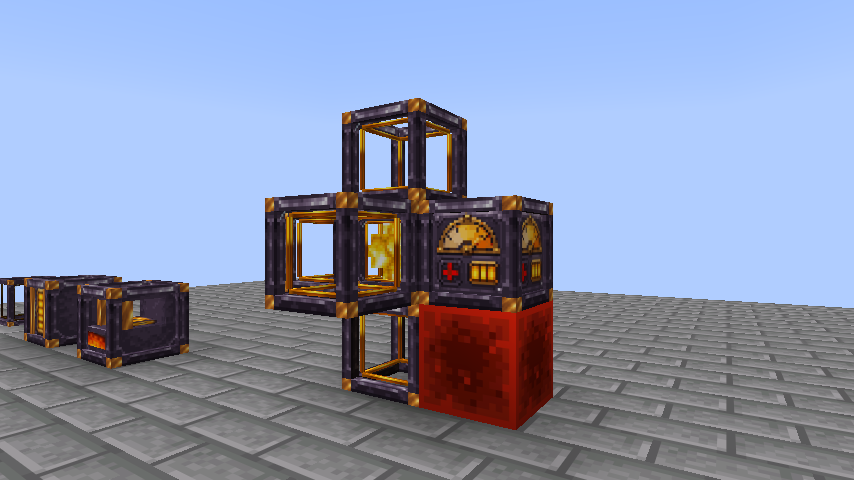
In game: a functioning six-face enclosure with transparent harvesters.
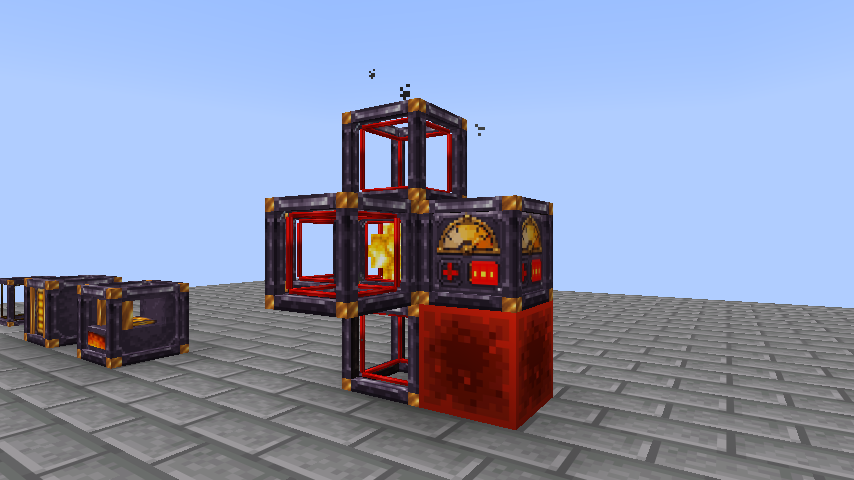
In game: red seams, flashing control indicator and exterior smoke during a blocked-output overload.
An explicitly bound Player Mirror can supply the owner’s remaining XP while offline. It does not load chunks or change this device’s normal cost. See network diagnostics.
Fusion feed and starvation
Pump Atomic Soup into a Solar Farm Control, or use an Atomic Soup Bucket. Each controller holds 64,000 soup (64 buckets); reserves from multiple controllers are available to the same enclosed sun. Default feeding is 1 soup per 256 E released. Food tracks requested release, including energy rejected by full harvesters, so blocked outputs are still dangerous. Fractional feed credits are saved with the shield block entity.
0% release pauses feeding and starvation, produces no electricity and cools containment. Full release consumes power × 20 / 256 soup per second. A power-16 sun needs 1.25 soup/s, releasing 320 E/s. One cobblestone gives 8 soup for 256 E: feeding that farm sustainably consumes 40 E/s on average, leaving 280 E/s for other work. Bootstrap with glowstone processing or stored soup/electricity.
Without enough soup, an active sun continues generating temporarily but permanently shrinks every 1,200 active ticks (60 seconds): lose 10% of current power rounded down, minimum one, with power never below one. After three unfed shrink events, the fusion reaction collapses into dormancy and generation stops. Example: power 16 → 15 → 14 → 13, then dormant. Closing release pauses the timer; adding soup automatically restarts dormant fusion at the smaller size when release is open. While active, fed ticks work down the starvation timer, and one continuous minute of feeding clears accumulated shrink-event warnings. A trickle below demand does not immediately reset starvation.
Soup does not restore lost power. Recover the sun into a Solar Shield and use the Solar Compressor's lava supply to increase power again. Dormancy and starvation progress survive saving and pickup, so moving the sun cannot reset its warning period. A dormant released sun is inert until fed inside a farm again. Existing containment heat/damage is separate and is not repaired by soup.
The controller and shield show feeding/starvation/dormancy; controller displays reserve, full requested feeding rate and approximate runtime. The Network Monitor reports the same state. Runtime assumes a constant power/release setting and no further soup input.
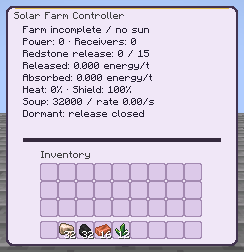
Actual controller displaying feed reserve/rate and containment heat. The test deliberately blocked electrical output.
Defaults are configurable through solar.electricity_per_soup=256, solar.starvation_shrink_ticks=1200, solar.starvation_shrink_percent=10, and solar.starvation_collapse_steps=3. Implementation.